



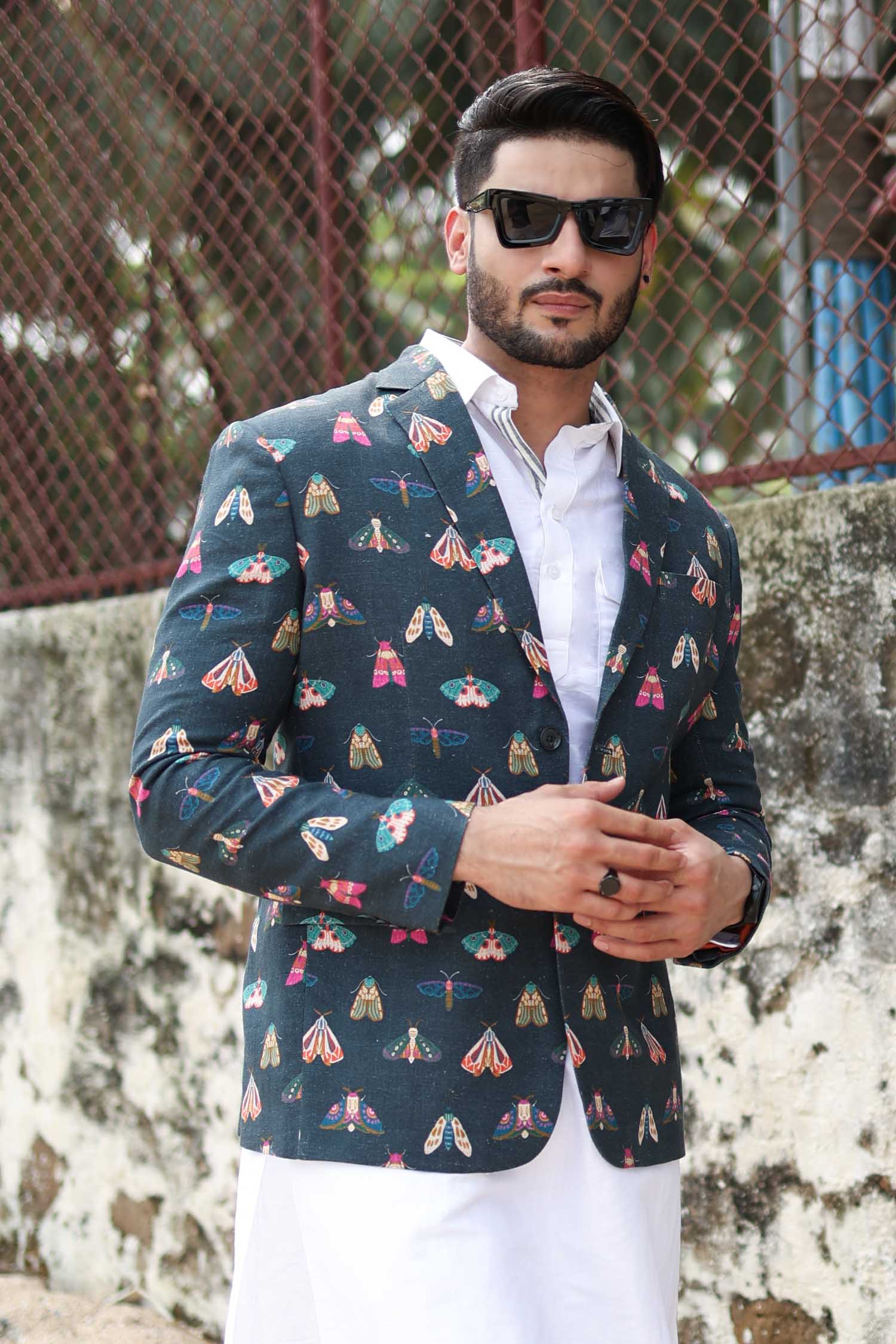


Befly | Men's Linen Blazer
Size Guide
Find your fit
Body measurements, in centimetres or inches.
Tailored through the shoulder and chest. If you're between sizes, size down for a closer fit or up for more room to layer.
| Size | XS | S | M | L | XL | XXL | XXXL | 5XL | 6XL |
|---|---|---|---|---|---|---|---|---|---|
| Size no. | 36 | 38 | 40 | 42 | 44 | 46 | 48 | 50 | 52 |
| Shoulder | 43.2 | 44.5 | 45.7 | 47 | 48.3 | 49.5 | 50.8 | 52.1 | 53.3 |
| Chest | 102 | 107 | 112 | 117 | 122 | 127 | 132 | 137 | 142 |
| Waist | 91.5 | 97 | 102 | 107 | 112 | 117 | 122 | 127 | 132 |
| Hips | 102 | 107 | 112 | 117 | 122 | 127 | 132 | 137 | 142 |
| Length | 70 | 71 | 72 | 74 | 75 | 76 | 77.5 | 79 | 79 |
| Sleeve length | 62 | 62 | 63.5 | 65 | 66 | 67.5 | 67.5 | 68.5 | 68.5 |
Tailored through the shoulder and chest. If you're between sizes, size down for a closer fit or up for more room to layer.
| Size | XS | S | M | L | XL | XXL | XXXL | 5XL | 6XL |
|---|---|---|---|---|---|---|---|---|---|
| Size no. | 36 | 38 | 40 | 42 | 44 | 46 | 48 | 50 | 52 |
| Shoulder | 43.2 | 44.5 | 45.7 | 47 | 48.3 | 49.5 | 50.8 | 52.1 | 53.3 |
| Chest | 102 | 107 | 112 | 117 | 122 | 127 | 132 | 137 | 142 |
| Waist | 91.5 | 97 | 102 | 107 | 112 | 117 | 122 | 127 | 132 |
| Hips | 102 | 107 | 112 | 117 | 122 | 127 | 132 | 137 | 142 |
| Length | 70 | 71 | 72 | 74 | 75 | 76 | 77.5 | 79 | 79 |
| Sleeve length | 62 | 62 | 63.5 | 65 | 66 | 67.5 | 67.5 | 68.5 | 68.5 |
Cut for a roomy layered fit through the shoulder and chest, with an extra-long body. If you're between sizes, size up for more room to layer.
| Size | XS | S | M | L | XL | XXL |
|---|---|---|---|---|---|---|
| Size no. | 36 | 38 | 40 | 42 | 44 | 46 |
| Shoulder | 43.18 | 44.45 | 45.72 | 46.99 | 48.26 | 49.53 |
| Chest | 102 | 107 | 112 | 117 | 122 | 127 |
| Waist | 91.5 | 97 | 102 | 107 | 112 | 117 |
| Hips | 102 | 107 | 112 | 117 | 122 | 127 |
| Length | 107 | 107 | 110 | 110 | 112 | 112 |
| Sleeve length | 62 | 62 | 63.5 | 65 | 66 | 67.5 |
Comfortable through the chest with room to move. True to size — order what you'd normally wear.
| Size | XS | S | M | L | XL | XXL | XXXL | 5XL | 6XL |
|---|---|---|---|---|---|---|---|---|---|
| Size no. | 36 | 38 | 40 | 42 | 44 | 46 | 48 | 50 | 52 |
| Shoulder | 43.2 | 44.5 | 45.7 | 45.7 | 47 | 48.3 | 49.5 | 50.8 | 52.1 |
| Chest | 101.6 | 106.7 | 111.8 | 116.8 | 121.9 | 127 | 132.1 | 137.2 | 142.2 |
| Waist | 88.9 | 94 | 99.1 | 104.1 | 109.2 | 114.3 | 119.4 | 124.5 | 129.5 |
| Hips | 101.6 | 106.7 | 111.8 | 116.8 | 121.9 | 127 | 132.1 | 137.2 | 142.2 |
| Length | 69.9 | 71.1 | 71.1 | 73.7 | 73.7 | 76.2 | 76.2 | 78.7 | 78.7 |
| Sleeve length | 62.2 | 62.2 | 63.5 | 63.5 | 66 | 66 | 67.3 | 67.3 | 68.6 |
Relaxed through the body with a longer length for coverage. True to size — order what you'd normally wear.
| Size | XS | S | M | L | XL | XXL | XXXL | 5XL | 6XL |
|---|---|---|---|---|---|---|---|---|---|
| Size no. | 34 | 36 | 38 | 40 | 42 | 44 | 46 | 48 | 50 |
| Shoulder | 43.2 | 44.5 | 45.7 | 45.7 | 47 | 48.3 | 49.5 | 50.8 | 52.1 |
| Chest | 101.6 | 106.7 | 111.8 | 116.8 | 121.9 | 127 | 132.1 | 137.2 | 142.2 |
| Waist | 91.5 | 97 | 102 | 107 | 112 | 117 | 122 | 127 | 132 |
| Hips | 101.6 | 106.7 | 111.8 | 116.8 | 121.9 | 127 | 132.1 | 137.2 | 142.2 |
| Length | 106.7 | 109.2 | 111.8 | 111.8 | 114.3 | 114.3 | 116.8 | 116.8 | 119.4 |
| Sleeve length | 62.2 | 62.2 | 63.5 | 63.5 | 66 | 66 | 67.3 | 67.3 | 68.6 |
Same body measurements as our Blazer / Jacket chart, minus the sleeve — layer it over a shirt or wear it on its own.
| Size | XS | S | M | L | XL | XXL | XXXL | 5XL | 6XL |
|---|---|---|---|---|---|---|---|---|---|
| Size no. | 36 | 38 | 40 | 42 | 44 | 46 | 48 | 50 | 52 |
| Shoulder | 43.2 | 44.5 | 45.7 | 47 | 48.3 | 49.5 | 50.8 | 52.1 | 53.3 |
| Chest | 102 | 107 | 112 | 117 | 122 | 127 | 132 | 137 | 142 |
| Waist | 91.5 | 97 | 102 | 107 | 112 | 117 | 122 | 127 | 132 |
| Hips | 102 | 107 | 112 | 117 | 122 | 127 | 132 | 137 | 142 |
| Length | 70 | 71 | 72 | 74 | 75 | 76 | 77.5 | 79 | 79 |
Measured at the natural waist. If you're between sizes, size up for more room through the hip and thigh.
| Size | XS | S | M | L | XL | XXL | XXXL | 5XL | 6XL |
|---|---|---|---|---|---|---|---|---|---|
| Size no. | 36 | 38 | 40 | 42 | 44 | 46 | 48 | 50 | 52 |
| Length | 104.1 | 104.1 | 106.7 | 106.7 | 106.7 | 109.2 | 109.2 | 111.8 | 111.8 |
| Waist | 81.3 | 86.4 | 91.4 | 96.5 | 101.6 | 106.7 | 111.8 | 116.8 | 121.9 |
| Hips | 94 | 99.1 | 104.1 | 109.2 | 114.3 | 119.4 | 124.5 | 129.5 | 134.6 |
| Thigh | 61 | 63.5 | 66 | 68.6 | 71.1 | 73.7 | 76.2 | 78.7 | 81.3 |
How to measure
- Shoulder — measure across the back, from the edge of one shoulder to the other.
- Chest — measure around the fullest part of the chest, keeping the tape level.
- Waist — measure around the natural waistline, where the body bends side to side.
- Hips — measure around the fullest part of the hips.
- Length — measure from the base of the collar/waistband down to the hem.
- Sleeve length — measure from the shoulder edge to the wrist.
- Thigh — measure around the fullest part of the thigh.
Tip: for the closest fit, compare these measurements to a similar garment you already own and love the fit of, rather than relying on body measurements alone.
Materials
- Shell Fabric: 40-Lea 100% Linen
- Lining Fabric: Cotton satin
- Fully lined (OEKO-TEX certified cotton interlining)
- Buttons: Corozo, Matching colors
- Reactive Printing: The Most Advanced Method of Fabric Printing
Design
- Single-breasted blazer (2 buttons opening)
- Notch lapel
- Functional sleeves (4 Buttons opening)
- Rear side vents
- 2 Flap pockets and a chest pocket at front
Fit
- Comfort Fit
- Customisation: Custom sizing available, or choose from standard sizes XS–XXL.
Look
- This model Brij, is 6'01'' tall and has 107cm (42") around the chest and 79 cm (31") around the waist and wears an L-Large.
- When in doubt, consult our size guide or email us at info@adamleaves.com.
-
 A dry wash is recommended.
-
 Medium heat ironing, with a press cloth to protect any eco-print.
This piece is structured with interlining and tailored finishing, so we recommend professional dry cleaning rather than washing at home — skip both hand and machine washing.
Spot-clean small marks right away with a soft, dry cloth, and air it out on a broad-shouldered hanger after each wear rather than washing every time.
Store away from direct sunlight to hold its shape and colour. If it's ever caught in rain, don't fold it while damp — hang it to air-dry fully before storing.
Order Dispatch:
All orders are processed and dispatched within 5-10 business days after confirmation.
Estimated Transit Time:
- Within India: Orders are typically delivered within 3-5 business days after dispatch.
- International: Delivery usually takes 5-12 business days, depending on the destination and customs clearance.
Please note: Delivery timelines may vary slightly due to unforeseen circumstances such as weather conditions or public holidays. International orders do not include customs duties, import taxes, or local fees — these are the customer's responsibility to pay upon delivery.
Returns & Exchanges
Most of our garments are made to measure. We offer an easy 7-day exchange for sizing or fit adjustments from the date of delivery. Returns are accepted only if the item arrives damaged, within 3 days of delivery, and require prior confirmation from our team before sending it back — email us at info@adamleaves.com with proper photograph and videos so we can approve the return.
Each Adam Leaves Eco-printed piece is crafted by hand using real flowers and leaves, so variation in the print pattern, color, and placement is a natural mark of the process — not a misprint or damage, and is not eligible for return or exchange.
Every Adam Leaves piece is cut and hand-stitched from natural materials — nothing about our construction process is mass-produced.
Because our fabrics are natural and undergo minimal processing, slight variations in texture, weave, and tone are normal, not a defect.
Lighting conditions and screen calibration can also make colours appear slightly different from what you see here.
These small differences are part of the beauty. Wear it with confidence — it's luxurious, versatile, and made just for you.

Befly | Men's Linen Blazer
Behind The Design

How It's Made
Testimonials
The Material Difference
Linen vs. Polyester
Life-cycle assessment · per kg of finished fiber · cradle-to-gate (raw material extraction through primary fiber processing)
| Linen | Polyester | |
|---|---|---|
| Water | 214 L | 62–200 L |
| Energy | 8–10 MJ | 108–217 MJ |
| CO2 | Data varies | 2.0–27.2 kg |
| Source | Renewable | Fossil fuel |
| Fertilizer & pesticides | Low | None (industrial synthesis instead) |
| Microplastics | None | High |
| End of life | Biodegradable | Non-biodegradable |
Better Moderate Higher impact
The trade-off: Linen is dramatically more energy-efficient than polyester and sheds no microplastics, but the retting process (breaking down flax stalks to release fiber) can use more water than polyester's synthesis. Linen's overall footprint remains far smaller thanks to its renewable, biodegradable nature.
Why the ranges vary: Published CO2 figures for linen vary widely depending on retting method (dew retting vs. water retting) and regional farming practices, so we show it as "data varies" rather than a specific range.
Methodology & data notes
- Water: Linen's figure reflects retting — dew retting uses natural rainfall, while water retting submerges stalks and uses more. Polyester's water use is mostly for equipment cooling during chemical synthesis.
- Energy: Linen processing is largely mechanical (scutching, hackling) with minimal energy input. Polyester relies on energy-intensive petroleum cracking and polymerization.
- CO2: Published figures for linen vary significantly by region and retting method, so no single range is shown. Polyester's emissions vary with the energy grid — coal vs. renewables — used in manufacturing.
- Source: Linen comes from the flax plant, an annual crop that needs minimal irrigation and few pesticides. Polyester is derived entirely from petroleum and natural gas extraction.
- Fertilizer & pesticides: Flax is a low-input crop, typically needing far fewer pesticides than cotton and only moderate fertilizer. Polyester uses no agricultural chemicals, but its production relies on petrochemical catalysts and industrial processing chemicals instead.
- Microplastics: Polyester sheds synthetic microfibers during washing, which accumulate in marine ecosystems. Linen is a natural cellulosic fiber and does not shed plastic.
- End of life: Untreated linen naturally decomposes and can be composted. Polyester can persist in landfills for centuries, though it can be mechanically recycled.


Other Linen products


Grove | Women's Linen Blazer


Bay | Women's Linen Shirt


Taru | Maternity Edit Linen Shirt


Sunrise | Maternity Edit Linen Dress
Sunrise | Women's Eco-Printed Linen Dress


Pine | Men's Linen Shirt


Kale | Men's Linen Blazer


